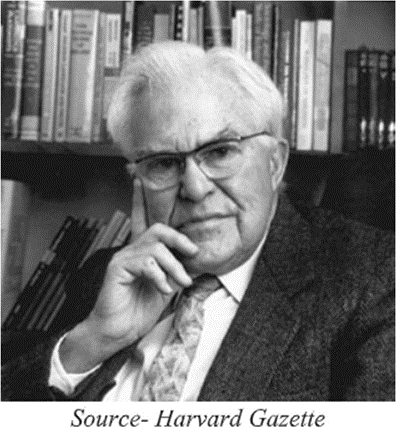
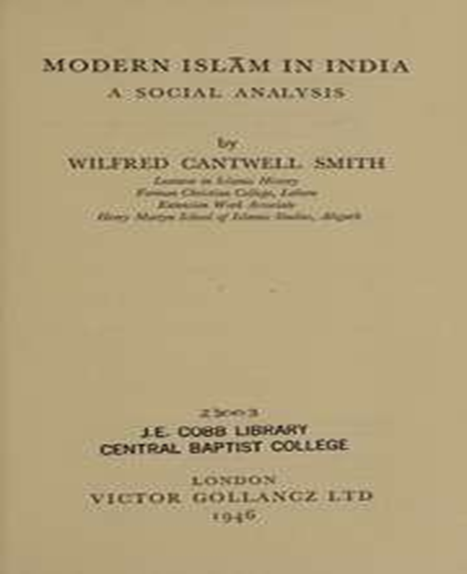
In 1943, Canadian scholar Wilfred Cantwell Smith published Modern Islam in India: A Social Analysis, a study written at a moment when neither Pakistan nor the Partition of India had yet solidified into historical certainties. Smith was observing Indian Muslims within a still-united colonial India, a society in flux, where tradition, religion, modern politics, and new economic ideas were colliding and reshaping collective life.
What fascinated Smith was not simply Islam as a belief system, but Muslims as a community undergoing political transformation. He famously described them as a “medieval religious community” entering modernity— engaging, often uneasily, with nationalism, capitalism, and even socialist thought. His analysis was not predictive in a narrow sense; rather, it was diagnostic, attentive to the deeper social processes unfolding beneath overt political events.
In the Preface, Smith highlighted two parallel and interconnected developments. One was Hindu–Muslim communalism, which he saw as deeply ambivalent. It could function as a tool of imperial governance, but it also carried the potential for internal rupture and long-term conflict. The other was the rise of the Muslim League, which Smith interpreted not merely as a political party, but as the organized expression of Muslim collective self-awareness.
Crucially, he did not treat these as separate or competing forces. For Smith, both were manifestations of a single historical transition: the entry of a religious community into the arena of modern politics.
With the benefit of eight decades of hindsight, the trajectories Smith cautiously outlined now appear far clearer. The communalism he viewed as a dangerous but uncertain possibility in colonial India eventually crystallized into a powerful, state-aligned ideology. Within this framework, Muslims increasingly came to be framed as a political problem and, over time, as a matter of security. The process of nation- building thus produced not integration, but marginalization, embedding exclusion within the logic of the modern state.
The alternative political possibility Smith identified took institutional form in Pakistan. Despite its many political, constitutional, and governance failures, Pakistan has continued to offer a socially recognized space for Muslim political existence. Here, Islam operates less as a defensive marker of identity and more as a constitutional and civilizational reference. Pakistan, in this sense, is not a completed project but a continuing one still struggling to define the moral and intellectual foundations of its statehood.
One of Smith’s most evocative images is that of the “young Muslim in a Lahore coffee house,” caught between inherited traditions and the uncertainties of a modern political future. In 1943, the central question facing that figure was how a nation comes into being. Today, the question has changed. It is no longer simply about origin, but about endurance: on what ethical, political, and intellectual grounds do nations sustain themselves over time?
Revisiting Wilfred Cantwell Smith reminds us that Muslim political modernity was never a settled destination. It was, and remains, an ongoing negotiation, between faith and politics, community and state, aspiration and reality. The questions he posed continue to resonate, not as relics of a bygone era, but as unresolved challenges of the present.