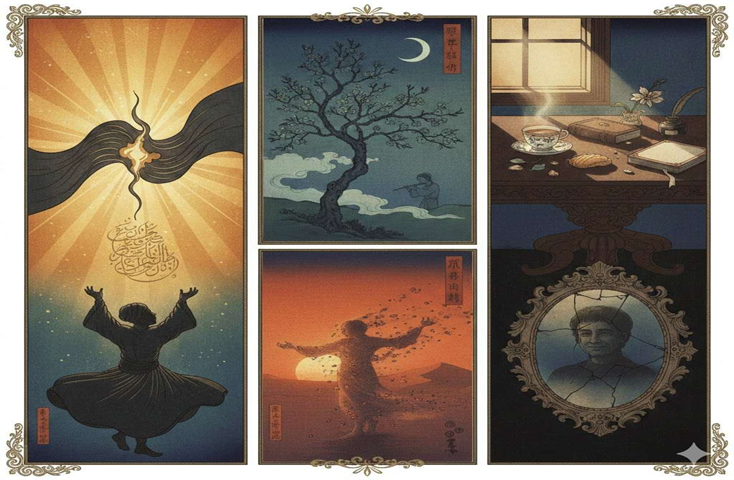
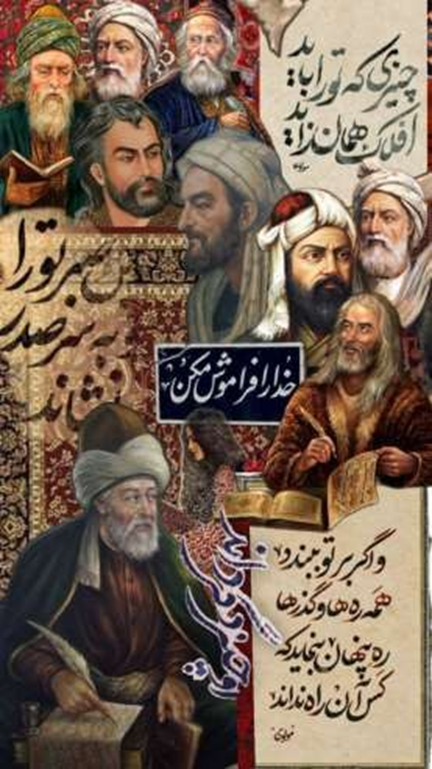
Persian poetry does not announce itself loudly. It enters quietly, like a memory you did not know you were carrying. It speaks in metaphors because truth, in this tradition, is too delicate to be stated plainly. To read Persian poetry is not to consume words, but to sit beside them and listen. This poetry was born in lands shaped by deserts and gardens, by exile and homecoming. It grew in Persia not as decoration, but as survival. When kingdoms fell and languages were threatened, poetry remained—soft, persistent, unforgettable.
At the center of Persian poetry is ishq, love. But not the fragile love that demands, nor the shallow love that fades. It is a love that burns and purifies. A love that asks for surrender. As Rumi writes, “Love is the bridge between you and everything.” Rumi’s poetry moves like a living body. His verses whirl, collapse, and rise again. “Why are you so busy with this or that or good or bad,” he asks, “pay attention to how things blend.” For Rumi, separation is an illusion; everything belongs to the same divine rhythm. Reading Rumi feels less like reading and more like being called. “Yesterday I was clever, so I wanted to change the world,” he confesses, “Today I am wise, so I am changing myself.” His poetry insists that transformation begins inward, quietly, honestly.
Before Rumi walked this path, Attar of Nishapur mapped it. In The Conference of the Birds, Attar tells of birds searching for their king, only to discover that what they seek is their own reflection. “You were the Simurgh,” Attar whispers, reminding us that the seeker and the truth are never separate.
If Rumi is devotion in motion, Hafez is devotion in disguise. His poetry smiles while it exposes hypocrisy. “I am in love with every church,” Hafez declares, “and mosque, and temple.” With a single line, he dismantles the walls we insist on building between faiths. Hafez often writes of wine, but it is never merely wine. It is freedom. It is defiance. It is truth unfiltered. “I have learned so much from God,” he writes, “that I can no longer call myself a Christian, a Hindu, a Muslim.” His poetry refuses labels, choosing sincerity instead.
Saadi of Shiraz writes with gentler authority. His words feel like advice from someone who has seen enough suffering to choose kindness deliberately. “Human beings are members of a whole,” he writes, “in creation of one essence and soul.” These lines now sit at the United Nations, yet they were born from a poet’s quiet moral clarity.
In Golestan and Bustan, Saadi blends wisdom with everyday life. He does not idealize humanity; he understands it. His poetry teaches that compassion is not weakness—it is responsibility. Then there is Ferdowsi, whose Shahnameh carried an entire civilization on its back. At a time when Persian language risked disappearance, he preserved it through epic verse. “I suffered much pain and strife,” Ferdowsi writes, “but I revived the Persian language.” His poetry is memory standing its ground.
Omar Khayyam enters this tradition as a questioner. He doubts, wonders, and laughs softly at certainty. “Be happy for this moment,” he urges, “this moment is your life.” His quatrains remind us that time is brief, and arrogance unnecessary.
Persian poetry does not end in the past. Forugh Farrokhzad arrives with a modern voice—bold, intimate, and unafraid. “I will plant my hands in the garden,” she writes, “I will grow, I know.” Her poetry claims space for women, desire, and selfhood. What unites these poets is their refusal to divide the sacred from the human. In Persian poetry, God appears in longing, grief, love letters, silence, and song. The divine is not distant, it is painfully close.
This poetry does not promise answers. It teaches patience with questions. It tells us that uncertainty is not failure, but faith in motion. “Try not to resist the changes that come your way,” Rumi advises, “instead, let life live through you.” To read Persian poetry is to understand that language can outlive empires. That words, written with honesty, can cross centuries intact. These poems survive because they speak to something that does not age:the human soul.
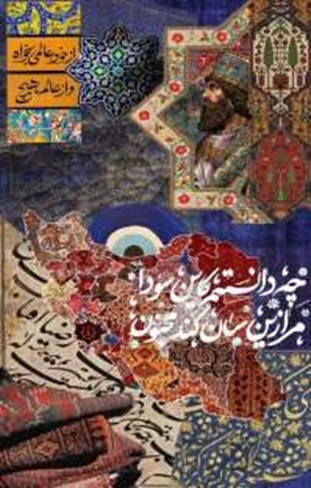
And perhaps that is why Persian poetry still breathes. Because it does not belong to history alone. It belongs to anyone who has ever loved, doubted, waited, or searched and refused to stop feeling.