“If you’re reading this, it means I have been killed — most likely targeted — by the Israeli occupation forces. When this all began, I was only 21 years old — a college student with dreams like anyone else. For past 18 months, I have dedicated every moment of my life to my people. I documented the horrors in northern Gaza minute by minute, determined to show the world the truth they tried to bury. I slept on pavements, in schools, in tents — anywhere I could. Each day was a battle for survival. I endured hunger for months, yet I never left my people’s side.
By God, I fulfilled my duty as a journalist. I risked everything to report the truth, and now, I am finally at rest — something I haven’t known in the past 18 months. I did all this because I believe in the Palestinian cause. I believe this land is ours, and it has been the highest honor of my life to die defending it and serving its people.
I ask you now: do not stop speaking about Gaza. Do not let the world look away. Keep fighting, keep telling our stories — until Palestine is free.” — For the last time, Hossam Shabat, from northern Gaza.
Palestine, the land of olives and cultures. A land where the world would find the bravest souls. A land whose freedom and joy has been neglected and prohibited since 1948. There have been many souls who stood up for the protection of this land yet there are some who left a mark which outshines the stain left on humanity — — Journalists. The dictionaries call them people who write for newspapers, magazines, or news websites or prepare news to be broadcast. But in recent years we have come to witness a meaning to this profession which goes far beyond dictionaries. What we witness in today’s world is the deadliest and the cruellest conflict on journalists. The Israeli Defence Forces execute and murder journalists every day. What we witness today are the last breaths of journalists who have kids and families. We witness as bullets filter through their bodies. We witness as they breath their last facing the Palestinian sky. We witness as they fearlessly enter battlefields, knowing any moment might be their last.
What we witness today is an attack on human rights, democracy and humanity.
Journalism is often considered to be a pillar of democracy alongside judiciary, executive and legislature. The United Nations ensures the rights of journalists and media workers, yet these rights are violated. Hassan Aslih, Shireen Abu Aqleh, Fatima Hassouna, Yahya Sobeih and the list goes on. Journalists and media workers working in Palestine sleep in tents, under ruined roofs, drink contaminated water, starve for months, witness the slaughter of Palestinian children, rape of women and execution of men.
The attack on these pillars of democracy and human rights is yet another step towards silencing the voices of the Palestinians. The current Israel’s war on Gaza is said to be the deadliest conflict ever for journalists. According to Costs of War Project, more journalists have been killed in Gaza in this war than in both world wars, Vietnam, Yugoslavia and Afghanistan combined, which suggests the heavy war Israel has waged on Journalists and protectors of Democracy.
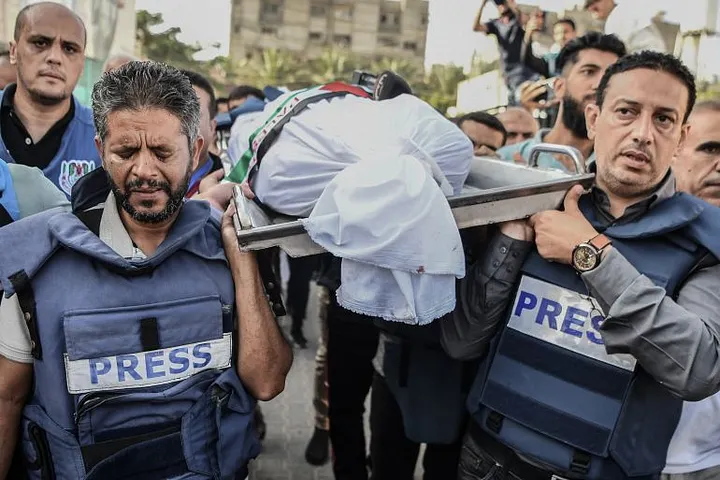
According to International Federation of Journalists, at least 170 journalists and media workers have been killed in Palestine as of 06 June 2025. Along with hundreds of deaths, several have been injured and many remain missing while the attack on Palestine gets heavier day by day. The attack on hospitals has been intensified and often times hospitals have been the prime target of Israeli offenses. The journalists get injured. They are then admitted to a hospital. Israeli military then bombs the hospital, killing civilians, including doctors, nurses and obviously journalists.
Middle East is considered to be one of the most hostile regions for journalists and media workers. Often times, these carriers of truth face political pressure and life threats but the will to preserve what’s left of humanity allows them to go on. While we hear news of these cruel occurrences, the blockage of aid reaching Gaza is not something new to our ears.
The experiences of a journalist working in Palestine can be described in two words: Coffins and Cameras. The camera initiates the journalist’s brave journey while the coffins mark the journey’s forceful end.
When Shireen Abu Akleh was killed by a Israeli military bullet while reporting and covering a raid on the Jenin refugee camp in the Israeli occupied west bank, wearing a blue press vest, it was made clear that the International Laws held no value for the State of Israel. The perspective of considering a vest wearing journalist with a camera to be an enemy of the state has been long present in the Israeli military. Killing of Boston Globe journalist Anthony Shadid in 2002, Reuters journalist Fadel Shana in 2008 and the killing of Reuters journalist Issam Abdallah in 2023 only further provide us proofs of the hostile nature with which Israel treats democracy and justice.
What we witness today is an attack on the international laws. Today’s condition of journalists in the middle east makes us question the implementation of the international laws. It makes us question — — Is the International Law dead?
“Today’s condition of journalists in the middle east makes us question the implementation of the international laws. It makes us question — — Is the International Law dead?”